Links
Sign in to access the Paper PDF.
Abstract
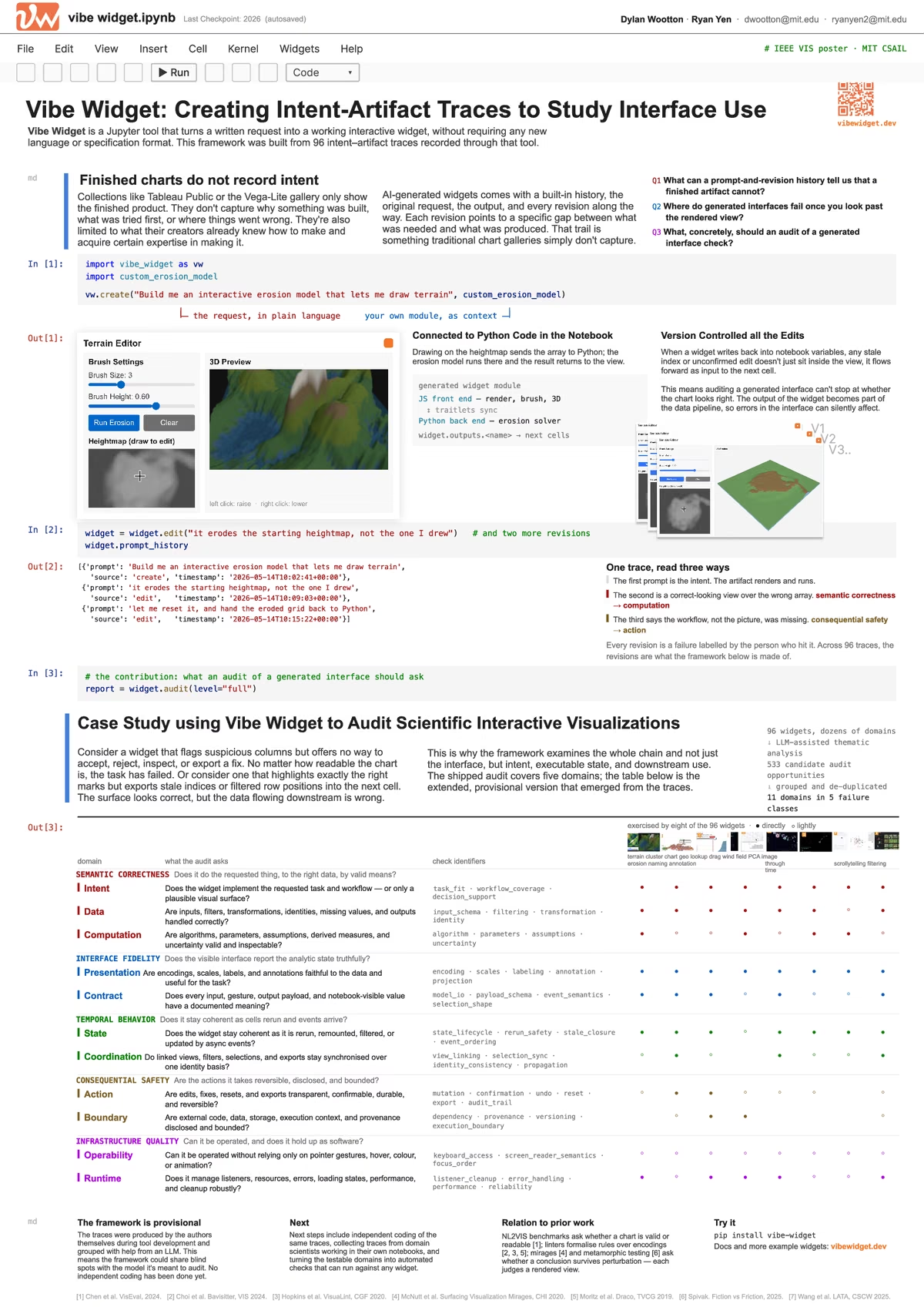
We present intent-artifact traces, a methodology for studying AI-assisted interface authoring by recording generated artifacts alongside the natural-language instructions used to create, revise, and repair them. We instantiate this methodology in VibeWidget, an open-source Jupyter tool that generates interactive scientific data interfaces from natural-language prompts. Each trace preserves the successive prompts, artifacts, and revisions through which an interface evolves, making mismatches between expressed intent and generated implementation available for analysis. As a case study, we analyze traces from 96 author-generated widgets using a two-stage LLM-assisted procedure: GPT-5 identified 533 candidate audit opportunities, which were then clustered and summarized through LLM-based topic modeling. This process produced a provisional taxonomy spanning semantic correctness, interface fidelity, behavior, safety, and operation. Our findings demonstrate how intent-artifact traces can support the systematic study and evaluation of AI-generated scientific interfaces.